







 新华报业网
新华报业网
BEIJING, Aug. 24 (Xinhua) -- In a significant push to stimulate consumer spending, China has rolled out an expansive trade-in policy across multiple sectors.
From automobiles and home appliances to real estate, the initiative aims to encourage the replacement of outdated goods with newer and more advanced options.
Experts believe that trade-in programs for consumer goods are more than just product replacement, but represent upgrades and quality improvements. Such programs not only bring higher-quality products but also stimulate consumer demand, energizing domestic consumption and reinforcing economic recovery. For businesses and industries, this presents a significant opportunity for growth.
AUTOMOBILES
Wu Qiang, a resident of eastern Jiangsu Province, recently received a 20,000 yuan (about 2,803 U.S. dollars) subsidy for trading in his 16-year-old fuel vehicle for an electric car through the trade-in program.
Initially, he considered selling his old car to a dealership for just 4,000 yuan. While he was weighing his options, China issued a new circular last week that increased financial incentives to encourage consumers to scrap their old vehicles and buy new ones.
According to the circular, subsidies for trade-ins of new-energy passenger vehicles have doubled from 10,000 yuan -- a figure stipulated in an April document -- to 20,000 yuan. Subsidies for trade-ins of fuel passenger vehicles have also risen from 7,000 yuan to 15,000 yuan.
Encouraged by the latest policy, Wu quickly decided to scrap his old car and purchased a new Mercedes-Benz Smart electric vehicle, then applied for the subsidy.
Dealerships are also seeing the opportunities. For instance, Jiang, a car salesman working at a shopping mall in Beijing's Chaoyang District, said that many customers are now upgrading their vehicles, with the trade-in program offering significant financial incentives.
Major automakers like FAW-Volkswagen, BAIC and Chery Automobile are also participating, offering up to 60,000 yuan in trade-in subsidies.
As of Thursday, the Ministry of Commerce has received over 680,000 applications for vehicle-scrapping subsidies. From January to July, over 3.5 million vehicles were scrapped and recycled, a 37.4 percent year-on-year increase.
HOME APPLIANCES
In the home appliance sector, the trade-in program has also been well-received.
Beijing resident Yu Qian recently purchased a new refrigerator. "My old refrigerator was outdated. When I learned about the trade-in policy, I decided to upgrade. The model I wanted was originally priced at 8,999 yuan, but with the trade-in subsidy and various discounts from the store, I ended up paying only 7,020 yuan, saving quite a bit of money."
Zhang Haibo, a sales supervisor at Suning, a major home-appliance retailer in China, echoed that many customers are attracted to the trade-in program, combined with government subsidies, store discounts and brand promotions.
Suning's data reveals that nearly 40 percent of its consumers have chosen to purchase new home appliances through trade-in programs this year, including air conditioners, washing machines and large-screen TVs.
China's e-commerce platforms like JD.com and Taobao are also providing diverse trade-in schemes for customers.
Wu Sa from the Chinese Academy of Macroeconomic Research pointed out that China, with its large population, has a vast market for durable goods, representing significant potential for the replacement market. The expected market space for replacing old automobiles and home appliances is expected to exceed one trillion yuan.
HOUSING
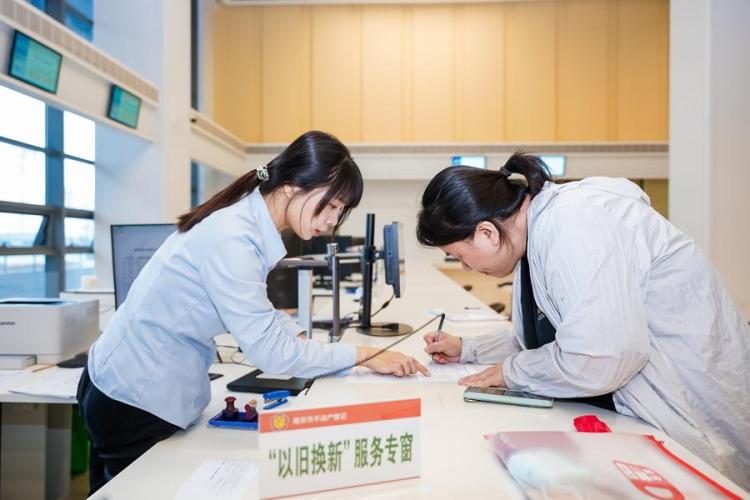
The housing sector has also embraced trade-ins, with over 100 cities encouraging homeowners to swap old properties for new ones with an additional payment. This scheme has been taken a step further in the Yangtze River Delta region, where intercity housing trade-ins are now available for the first time.
Under this new scheme, homeowners can trade in pre-owned residential properties, not just within Wuxi but also in the neighboring cities of Suzhou and Changzhou, for new homes in the Liangxi District of Wuxi.
Guo Feng, who works in Wuxi but owns a home in Suzhou, can now trade his property in Suzhou for one in Wuxi, thanks to the expanded program.
To date, nearly 140 transactions have been completed under this housing trade-in program.
Experts believe these trade-in programs address the demand for advanced, eco-friendly and personalized options, shifting the focus from mere availability to quality and innovation.







 Android版
 iPhone版